SCF 2026 | ACM Symposium on Computational Fabrication
Computational Design of Free-Form Lampshades
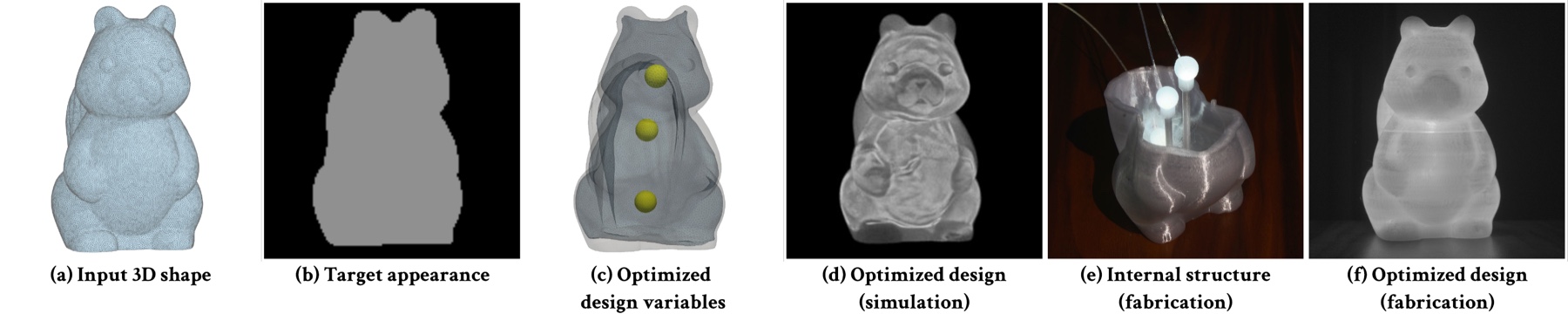
A computational design method that enables 3D-printable lampshades with complex free-form shapes to achieve controlled illumination, such as uniform luminance.
Demonstration video
Abstract
Conventional lampshades are predominantly restricted to simple geometries, owing to the difficulty of controlling optical functions across complex shapes. We present a computational design method that enables 3D-printable lampshades with complex free-form shapes to achieve controlled illumination, such as uniform luminance. Given an arbitrary shape, our method determines the internal cavity geometry and the number and placement of lights in two stages: an initialization stage fixes the number of lights and establishes their initial positions and the initial cavity geometry, after which gradient-based optimization jointly refines the cavity geometry and light positions via differentiable rendering subject to geometric constraints. We calibrate the material parameters of the translucent shade material prior to optimization to improve the agreement between simulation and the fabricated result. We validate our approach by 3D-printing five lampshade designs of varying geometric complexity and demonstrate that the fabricated lampshades achieve reasonably uniform luminance.
Acknowledgments
This work was supported in part by JSPS KAKENHI Grant Number JP26K14879. This research was conducted using the Supermicro ARS-111GL-DNHR-LCC and FUJITSU Server PRIMERGY CX2550 M7 (Miyabi) at Joint Center for Advanced High Performance Computing (JCAHPC). The Spot model is courtesy of Keenan Crane, the Bimba model is courtesy of the AIM@SHAPE Shape Repository, and the Stanford Bunny model is courtesy of the Stanford University Computer Graphics Laboratory.
Citation
@inproceedings{nakasuji2026lampshade,
  title = {Computational Design of Free-Form Lampshades},
  author = {Nakasuji, Hiro and Yokota, Soma and Ohtake, Yutaka and Koyama, Yuki},
  booktitle = {Proceedings of the 11th ACM Symposium on Computational Fabrication (SCF '26)},
  year = {2026},
  doi = {10.1145/3828611.3845638}
}